
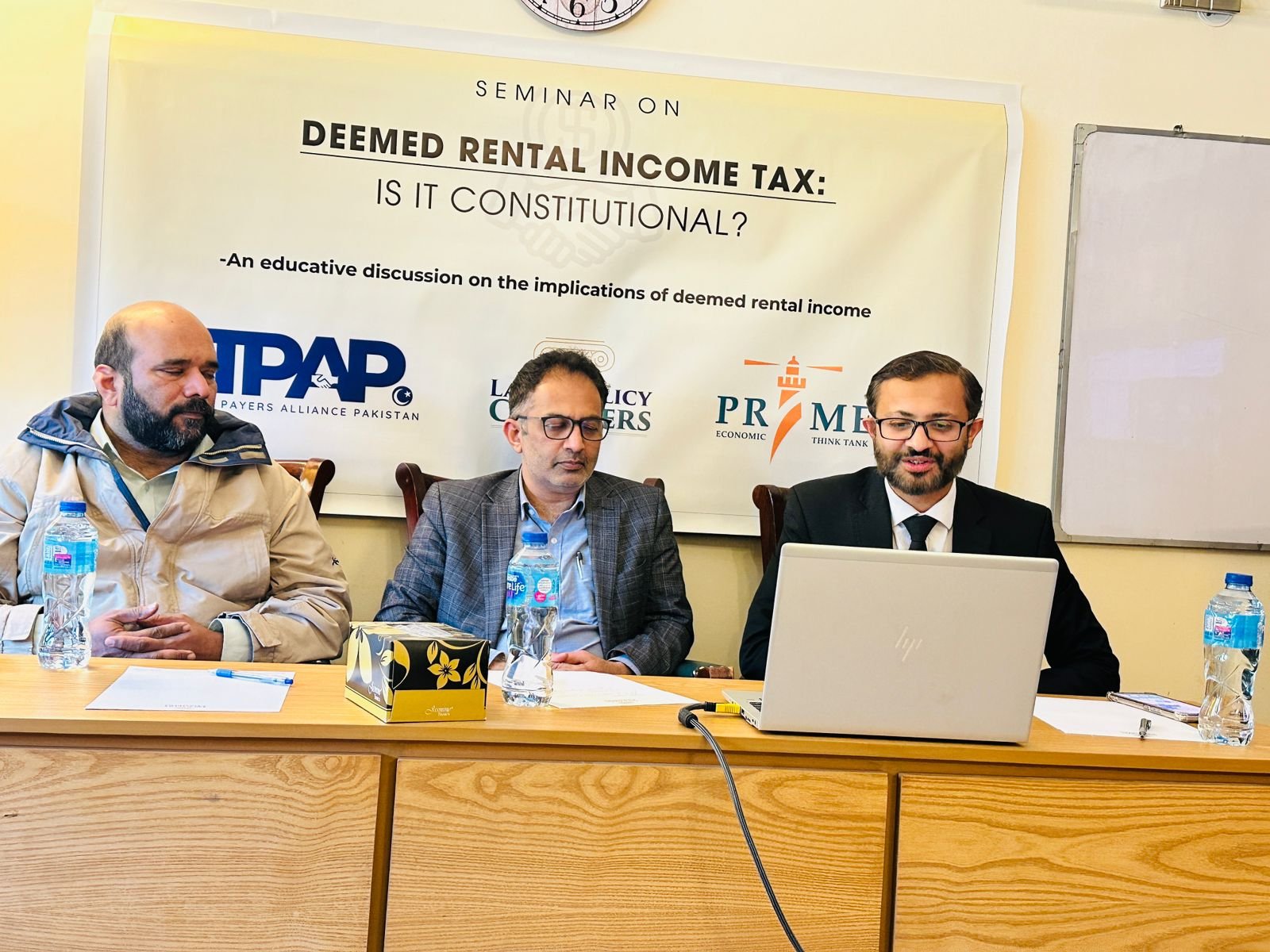
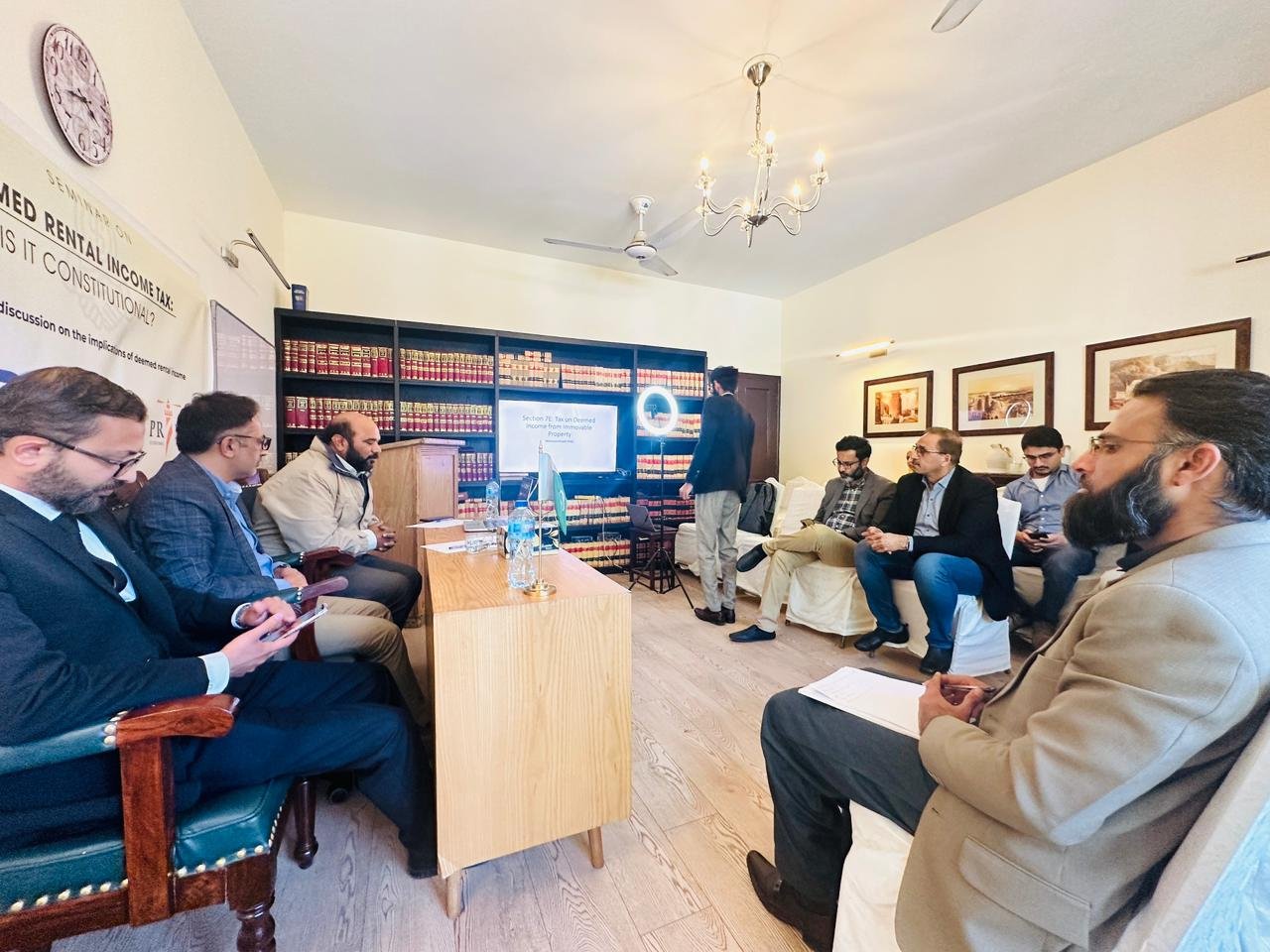


Speakers presenting at the TPAP seminar on deemed rental income taxParticipants attending the TPAP Section 7E seminar in IslamabadGuests and speakers following the TPAP Section 7E seminar

Press Room

Official Press Releases & Media.

Policy positions, public statements, expert seminars, and media appearances from Tax Payers Alliance Pakistan.

Tax Payers Alliance Pakistan

Public Record

A clear, evidence-led voice for taxpayer rights.

TPAP’s press room brings together formal policy statements, seminar outcomes, expert perspectives, and public media engagement — all on the public record.

Latest Statements

Press releases and policy positions.

Read TPAP’s complete public statements on tax enforcement, due process, taxpayer rights, and economic policy.

Joint Press Release7 May 2025

The Tax Laws (Amendment) Ordinance, 2025: Concerns Regarding Due Process, Judicial Oversight, and Taxpayer Rights

Islamabad, 7th May 2025 - Tax Payers Alliance Pakistan (TPAP) and the Policy Research Institute of Market Economy (PRIME) jointly express serious concerns over the recently issued Tax Laws (Amendment) Ordinance, 2025. Both organizations believe that certain provisions within the Ordinance could potentially affect fundamental legal safeguards and principles that are essential for a fair and transparent tax system.

Read full statement

The Ordinance, which amends Sections 138 and 140 of the Income Tax Ordinance, 2001 (XLIX of 2001), has prompted considerable discussion among legal experts, tax professionals, businesses, and civil society. While its stated goal is to expedite tax collection and improve enforcement, stakeholders are concerned that it may have implications for taxpayer rights and procedural due process.

Key Amendments of the Ordinance

Section 138(3A): Allows for immediate enforcement of tax liability where the issue has been decided by a High Court or the Supreme Court, regardless of contrary rulings, timelines, or procedural norms.

Section 140(6A): Enables swift recovery actions under similar conditions, potentially limiting a taxpayer's opportunity to contest or seek relief.

Chairman's Perspective

Raja Amer Iqbal, Chairman TPAP, notes that “these amendments will further marginalize existing taxpayers and discourage potential taxpayers from entering the tax base. Such policies may yield short-term revenue gains but will have negative ramifications on economic growth, exacerbate the parallel economy, and stifle private sector investment, including local and foreign. Ultimately, this could lead to increased unemployment among the youth.” He further mentions that “a balanced approach is crucial to fostering a conducive business environment and sustainable economic development.”

Legal and Constitutional Considerations

These provisions grant the Federal Board of Revenue (FBR) expanded authority to enforce recoveries even when a taxpayer may be seeking appellate review or pursuing legal remedies. This raises constitutional and legal concerns, particularly regarding the right to a fair hearing and due process.

In the landmark case of Elahi Cotton Mills Ltd. v. Federation of Pakistan (PLD 1997 SC 582), the Supreme Court emphasized the necessity of due process in tax recovery proceedings, underscoring that taxpayers must be afforded a fair opportunity to contest assessments before enforcement actions are initiated.

Several legal professionals have noted that the Ordinance appears to override established judicial precedents and procedural safeguards. The principle that individuals should have the opportunity to be heard before enforcement action is taken is a cornerstone of administrative justice. Curtailing this right may impact public confidence in tax administration and the authority of the judiciary.

Risk of Disproportionate Enforcement

Empowering tax authorities to recover liabilities immediately, even in the presence of ongoing legal challenges, may increase the risk of overzealous enforcement. There is concern that such discretion, without adequate checks and balances, could result in unintended consequences, particularly for compliant taxpayers facing disputed assessments.

Over 108,000 tax cases are currently pending in various courts across Pakistan, involving approximately Rs4.457 trillion in revenue. This backlog indicates systemic challenges in tax dispute resolution and underscores the need for balanced enforcement rather than expedited action without recourse.

Impact on Economic Climate

Predictability and fairness in tax administration are crucial for fostering business confidence. Sudden enforcement actions, especially near fiscal year-end, may be perceived as efforts to meet revenue targets without adequate taxpayer facilitation. Such perceptions could discourage investment and create uncertainty among both domestic and international investors.

The International Monetary Fund (IMF) has highlighted that Pakistan's narrow tax base and challenges in tax administration contribute to economic vulnerabilities. In its recent assessment, the IMF noted that strengthening governance and ensuring fair tax practices are crucial for fostering a conducive investment climate.

Stakeholder Perspectives and International Comparisons

TPAP and PRIME, along with allied organizations, have emphasized the need for balancing revenue imperatives with constitutional protections and judicial oversight. Legal experts have also raised caution against legislation that could appear to diminish the judiciary's role in adjudicating tax matters. A well-functioning taxation system should encourage voluntary compliance through transparency and fairness.

The Federation of Pakistan Chambers of Commerce and Industry (FPCCI) has expressed concerns over abrupt tax enforcement measures, stating that such actions can undermine business confidence and deter investment. The FPCCI advocates for a balanced approach that ensures compliance while safeguarding taxpayer rights.

The Organisation for Economic Co-operation and Development (OECD) recommends that tax administrations adopt transparent and fair procedures, ensuring that taxpayers have the right to appeal and that enforcement actions are proportionate. These best practices aim to build trust in the tax system and encourage voluntary compliance.

Call for Reassessment

Under the many reforms suggested by commissions and donor reports, an element of certainty and transparency was highlighted. Moreover, any change in the tax code, with the exception of Finance bill/budgets, was discouraged. Despite FBR being in the process of formulating budgetary proposals, sudden enforcement of major changes in compliance laws does not only jeopardize the fair and transparent fiscal process but also increases uncertainty about tax laws.

Businesses are already overburdened with predatory tax practices such as business-choking WHT tax regimes, excessive documentation, higher import stage taxes, while refunds and rebates, which should be swift and automated, are stuck and delayed beyond their normal timeframe. Such abrupt measures would only increase distrust on the government and increase informality in the economy and retard growth.

In view of these concerns, TPAP and PRIME jointly urge the government to ensure taxpayers retain the right to be heard before enforcement actions; align enforcement mechanisms with due process and judicial safeguards; maintain the independence and authority of the judiciary in tax-related matters; and foster a collaborative approach that supports long-term tax compliance.

The government has previously stated its commitment to promoting business and streamlining refund processes, as noted in the Revenue Division Yearbook 2023-24. In this context, the Ordinance's timing and scope may appear inconsistent with those stated objectives.

Effective tax administration must balance the need for timely revenue collection with the obligation to uphold taxpayer rights and legal safeguards. TPAP and PRIME encourage an inclusive dialogue involving policymakers, legal experts, and civil society to ensure that any future amendments support both fiscal responsibility and constitutional integrity.

About the Organisations

Tax Payers Alliance Pakistan (TPAP) is a citizen-led initiative advocating for a simplified and equitable tax regime. Hosted by PRIME Institute, it aims to foster constructive engagement with public policy and promote responsible taxation practices.

The Policy Research Institute of Market Economy (PRIME) is an independent think tank dedicated to advancing economic freedom and evidence-based policy reform in Pakistan.

For media inquiries: Sumaira Waseem, Communications Officer, PRIME - sumaira@primeinstitute.org

Read related media coverage
Press ReleaseFiscal Year 2025-26

TPAP Calls for Abolishment of Sections 37A & 37B of the Sales Tax Act, 1990 and Section 21(s) of the Income Tax Ordinance, 2001

For Fiscal Year 2025-26, the government has set a GDP growth target of 4.2% with an inflation rate of 7.5%. Federal tax revenue is set at an ambitious PKR 14,131 billion, based on a strong focus on compliance efforts and reforms in Federal Board of Revenue (FBR), digitalization initiatives, broadening the tax base and increase in withholding tax rates.

Read full statement

The Tax Payers Alliance Pakistan (TPAP), representing a broad spectrum of law-abiding taxpayers, professionals, and business individuals, strongly urges the Government and Federal Board of Revenue (FBR) to reconsider and withdraw the newly inserted Sections 37A and 37B of the Sales Tax Act, 1990 as well as section 21(s) of the Income Tax Ordinance, 2001. These provisions, while ostensibly aimed at curbing tax fraud, represent a disproportionate, coercive, and constitutionally questionable approach to tax enforcement.

Sections 37A and 37B

Section 37A of the Sales Tax Act, 1990 grants sweeping and quasi-police powers to Inland Revenue Officers, including the power to inquire, investigate, arrest, and prosecute taxpayers without sufficient judicial oversight. The provision effectively introduces criminal-style proceedings within the civil tax administration framework, thereby disrupting the balance of due process. It empowers tax officials to act as judge, investigator, and enforcer—resulting in an intimidating environment that erodes taxpayer confidence and discourages voluntary compliance.

Section 37B, which prescribes procedures following arrest, further aggravates the risk of abuse by allowing detention, custodial investigations, and physical remand without the safeguards typically afforded in criminal jurisprudence. This runs contrary to the principles of natural justice, fair trial, and economic liberty enshrined under the Constitution of Pakistan.

Section 21(s)

Section 21(s) of the Income Tax Ordinance, 2001, which disallows 50% of expenditure claimed against any sale for which payment exceeding Rs. 200,000 is not made through banking channels or digital means, is unduly harsh and disconnected from commercial realities.

In a country where the informal sector remains predominant and digital infrastructure is still evolving, this provision unjustly penalizes genuine transactions and burdens small- and medium-sized businesses. Instead of promoting documentation, it effectively punishes taxpayers for structural deficiencies in the economy.

TPAP's Position

TPAP strongly believes that revenue enforcement must be grounded in transparency, proportionality, and procedural fairness. Sections 37A and 37B represent excessive criminalization of tax administration, and Section 21(s) imposes unrealistic compliance burdens. These provisions are likely to result in taxpayer harassment, litigation overload, and economic uncertainty, ultimately undermining the FBR's stated objective of broadening the tax base.

In view of the foregoing, TPAP respectfully recommends that FBR should initiate the legislative process to withdraw Sections 37A & 37B of Sales Tax Act, 1990 and section 21(s) of the Income Tax Ordinance, 2001, with immediate effect and engage in meaningful consultation with all the stakeholders like business community, chambers of commerce & industry, trade bodies, lawyers/tax bar associations, professional accountants etc. to develop more balanced and practical enforcement mechanisms aligned with constitutional protections and economic realities. Pakistan's economy needs support, not sabotage in the name of digitalisation. There is need for reforms by those who understand how businesses really work.

About TPAP

Tax Payers Alliance Pakistan (TPAP) is a potent pressure group, comprising citizens of Pakistan from all walks of life to advise, educate and influence the Government and Public Policy in Pakistan to lowering the taxes on businesses and individuals, simplify the taxation regime, and to urge the government to eliminate undue and wasteful expenditures. PRIME Institute (Policy Research Institute of Market Economy) serves as its Secretariat in Islamabad.

Seminar Press Release21 March 2024

Historic Seminar on Section 7E: TPAP and Law & Policy Chambers Call for Abolishment of Deemed Rental Income Tax

Tax Payers Alliance Pakistan (TPAP) – an initiative of economic think tank PRIME (Policy Research Institute of Market Economy), in collaboration with Law & Policy Chambers organized historic seminar on 9th March 2024 in Islamabad, shedding light on the contentious issue of the Deemed Rental Income Tax levied under section 7E of the Income Tax Ordinance, 2001 vide Finance Act, 2022.

Read full statement

The event brought together a diverse group of experts including economists, lawyers, tax professionals, civil society activists, and academia – attended by huge audience both in person and online – to discuss the detrimental impacts of this tax on the public.

Expert Discussion

Mr. Umer Ijaz Gilani, Advocate Supreme Court, elucidated the legal intricacies surrounding this tax, while discussing in detail its background and repercussions. He very nicely described the difference between “deemed income” and “non-existent/hypothetical income” to make it easily understandable to even a layman.

Dr. Ali Salman, Executive Director PRIME, highlighted the sheer violation of fair taxation principles and the need to protect property rights. Dr. Mahmood Khalid, Senior Research Economist, Pakistan Institute of Development Economics (PIDE) provided insights from a tax policy perspective, and Barrister Junaid Ahmed, joining virtually from Karachi, contributed invaluable insights regarding the implications of this tax for inheritance cases.

Constitutional and Public Policy Concerns

The Deemed Rental Income Tax, introduced vide Finance Act 2022, has been under scrutiny for its constitutionality and alignment with public policy. Notably, both the Islamabad High Court (IHC) and Peshawar High Court (PHC) have already declared it unconstitutional, with the matter currently sub judice before the Supreme Court of Pakistan.

The overwhelming consensus among the participants was that the deemed rental income tax, as stipulated under Section 7E of the Income Tax Ordinance, 2001, is not only unconstitutional and ultra vires but also runs contrary to public policy. The arguments put forth during the seminar highlighted the adverse effects of this tax provision on fair taxation principles, property rights protection, and the overall welfare of taxpayers.

Call for Abolishment

Given the compelling evidence presented at the seminar, Tax Payers Alliance Pakistan (TPAP) unequivocally calls for the immediate abolishment of the deemed rental income tax, void ab-initio. TPAP firmly believes that this tax not only violates the fundamental rights of taxpayers but also undermines the principles of fairness and hampers economic growth.

According to Mr. Anas Farhan, Convener Tax Payers Alliance Pakistan (TPAP), this seminar marks a significant step towards advocating for fair and just taxation policies in Pakistan. TPAP has also strongly urged the Government for abolishment of Section 7E, while submitting budgetary proposals to Revenue Division/Federal Board of Revenue (FBR) for the year 2024-25, he said.

About TPAP

Tax Payers Alliance Pakistan (TPAP) is a potent pressure group, comprising citizens of Pakistan from all walks of life to advise, educate and influence the Government and Public Policy in Pakistan to lowering the taxes on businesses and individuals, simplify the taxation regime, and to urge the government to eliminate undue and wasteful expenditures. PRIME Institute (Policy Research Institute of Market Economy) serves as its Secretariat in Islamabad.

Seminar Archive

Section 7E: Deemed Rental Income Tax

An educative seminar on the constitutionality and implications of deemed rental income tax under Section 7E of the Income Tax Ordinance. Held 9 March 2024, Islamabad.

01
UI

Mr. Umer Ijaz Gilani

Advocate Supreme Court, Partner, Law & Policy Chambers

Overview of the Case against Deemed Rental Income Tax

02
AS

Dr. Ali Salman

Executive Director, PRIME

Property Rights, Rule of Law and Taxation

03
MK

Dr. Mahmood Khalid

Senior Research Economist, PIDE

Tax policy perspective on deemed rental income

04
JA

Barrister Junaid Ahmed

Partner, JA Legal

Can the Dead Earn? Complications Created by Section 7E

Video Archive

TPAP in conversation.

Public briefings, policy commentary, interviews, and taxpayer-focused discussions.

TPAP Media Briefing

Taxpayer Policy Discussion

TPAP Public Commentary

TPAP Live Session

Tax Reform Discussion

Taxpayer Rights Commentary

TPAP Policy Perspective

Fiscal Policy Conversation

TPAP Media Appearance

Public Finance Discussion

Press & Media Inquiries

Get in touch with our communications team.

For press requests, media accreditation, or statements, contact PRIME Institute’s communications office.

Press Releases & Media | Tax Payers Alliance Pakistan